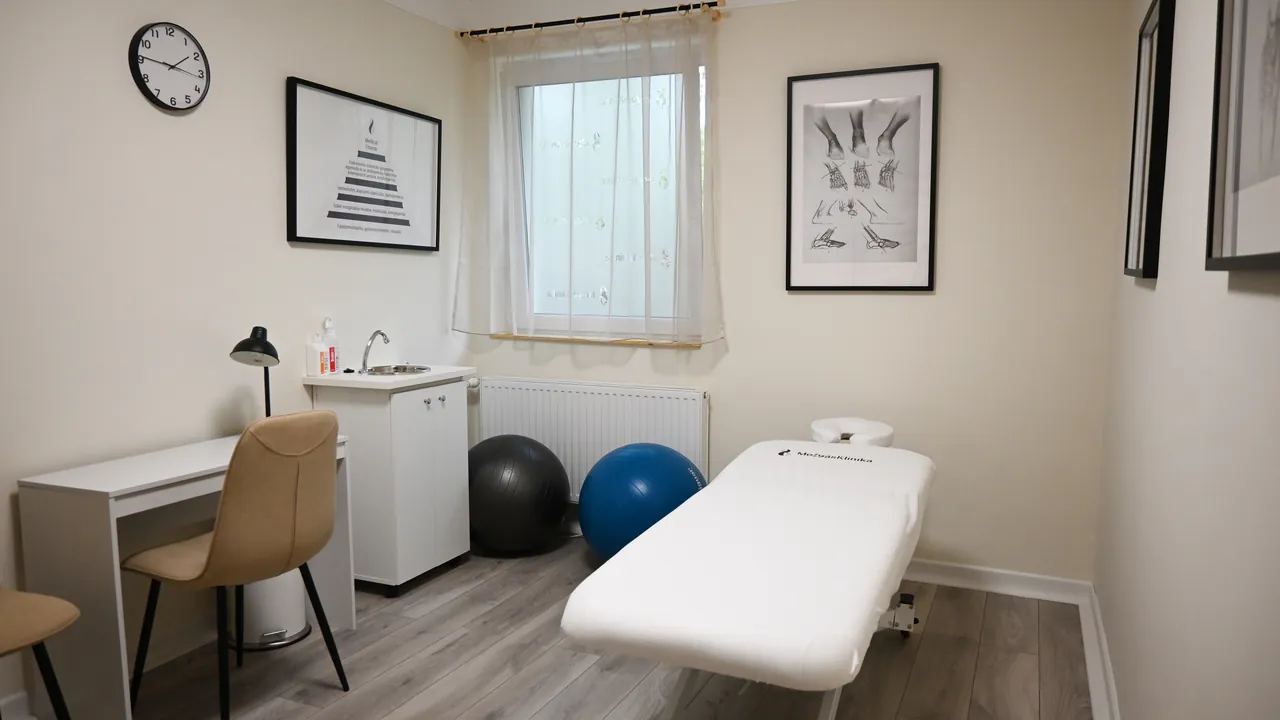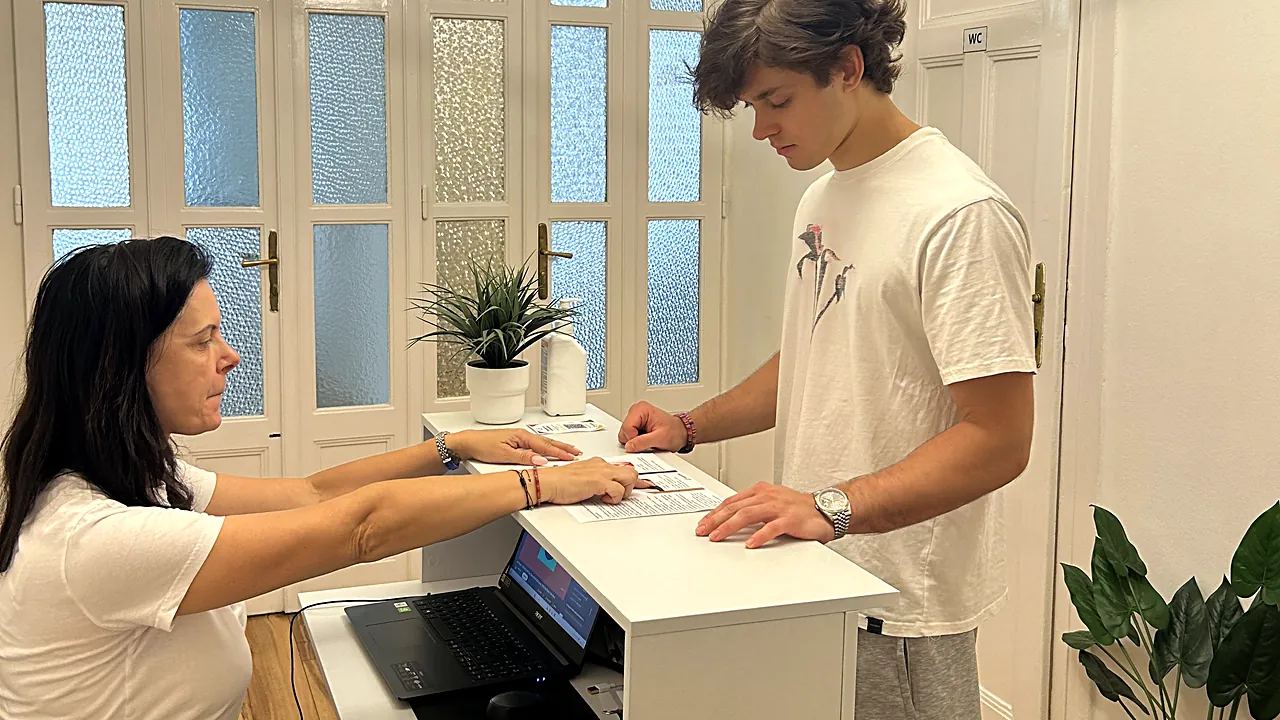
Your first visit to MozgásKlinika Újlipótváros, at Váci út 28 in Budapest’s 13th district (XIII. kerület), is a 60-minute assessment. You talk through your problem with the therapist, they look at any reports or scans you bring, test how you move, and give you a personal treatment plan. Then treatment starts in that same session. If you have never been to a physio in Hungary before, here is what the hour actually looks like.
A quick note on terms you will see on our site: gyógytorna is physiotherapy built around therapeutic exercise, and manuálterápia is manual (hands-on) therapy. Most first visits involve a bit of both.
What to bring and what to wear
You don’t need to prepare much. A few things do help, because the more the therapist can see of your history, the more useful the first hour becomes.
- Existing reports: hospital discharge notes, a specialist’s opinion, X-ray or MRI reports. If you have the images too (a CD or a download link), bring them. Reports in English are fine to bring.
- A list of any medication you take regularly.
- Your Hungarian health-fund card or SZÉP card, if you plan to pay with one.
- Comfortable clothes you can bend and lift your arms in. The therapist may need to see or examine the painful area, so for a shoulder or back problem a vest top or something easy to slip off is handy.
No reports at all? That’s fine. You don’t need to have seen anyone else first.
Getting to Váci út 28
The clinic is on Váci út between Lehel tér and Nyugati, directly opposite Westend, near the DM on Váci út. Once inside the building it’s a few steps and then a lift up to the mezzanine (Félemelet 2). The nearest metro stops are Lehel tér and Nyugati pályaudvar on the M3 line, and trams 4 and 6 stop at Nyugati tér. If you drive, the simplest option is the Westend underground car park, then cross Váci út. We’ve written up the route from the metro and from Westend in more detail.
Aim to arrive a few minutes early so you’re not rushing in. If you work in one of the offices along Váci út, an appointment before or after work may be the easiest fit. (Monday to Friday, 8:00–20:00)
How the physiotherapy assessment in Újlipótváros works
The hour follows the MozgásPiramis® (Movement Pyramid), the method used across every MozgásKlinika clinic in Hungary. The order below is typical rather than fixed; your therapist adapts it to what you tell them and what they find.
1. Talking it through
Where does it hurt, since when, what makes it worse, what eases it. What you do for work, how much you sit, whether you train, any past injuries or operations. None of this is small talk. The useful clue often turns up here, so mention anything that comes to mind, even if it seems unrelated.
2. Looking at your reports
If you’ve brought an MRI, an X-ray or a discharge summary, the therapist reads it alongside what you’ve described. A scan doesn’t settle everything on its own, because what shows up on an image and what you actually feel don’t always line up.
3. Movement tests
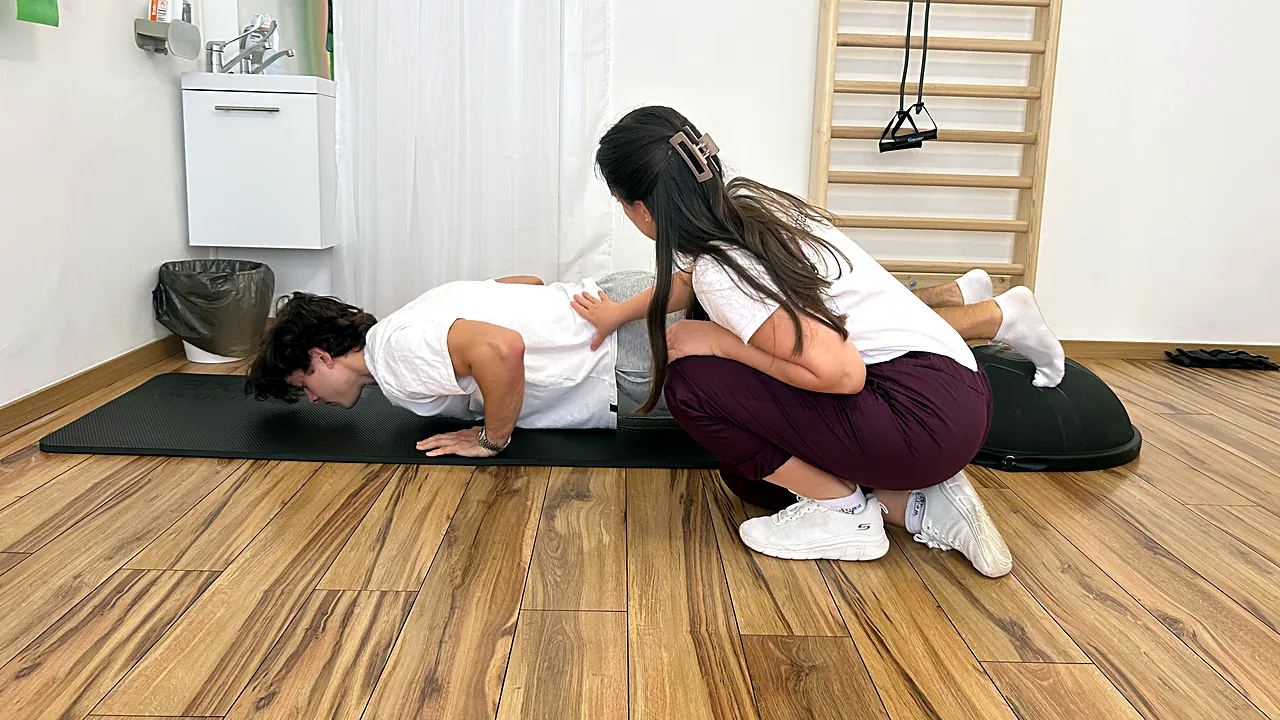
Next come standardised manual and functional orthopaedic tests. In practice the therapist watches how you bend, turn and stand up, checks how far the affected joints move, and examines the painful area by hand. If anything hurts, say so. You don’t have to grit your teeth.
4. Where you sit on the Pyramid
At the end of the assessment you’re placed on one of the Pyramid’s five levels. The base is pain relief and better circulation, mainly through manual therapy. Above that come restoring joint range of motion, correcting muscle weakness, building functional stability and, at the top, returning to sport or full activity. Your starting level shapes the first few weeks.
5. A plan, and treatment the same day
You leave with a recommendation made for you: what kind of treatment, how often, and what to expect. You aren’t sent home to start next time. Treatment begins in the same session, so the first hour is already therapy, not just paperwork.
How we work at MozgásKlinika Újlipótváros
- We map out your symptoms, your history and how you move.
- We build a treatment plan around you, based on the MozgásPiramis®.
- We start treatment at your very first visit.
Curious where you’d land on the Pyramid? Book a consultation (opens in a new tab).
Nervous about the first visit? That’s normal
Plenty of people arrive unsure whether they’ll need to undress, whether the tests will hurt, or whether their problem is “serious enough”. All fair questions, and doing this in a second language can add to the nerves. Your therapist explains each step before doing it, you can stop them at any point, and no problem is too small to bring in. Ask anything: what a word on your report means, why you’ve been given a particular exercise, what to do at home.
You also don’t need to decide in advance whether you need a physiotherapist or a manual therapist. The assessment sorts that out. If you’d like to read up anyway, see when it’s worth seeing a physiotherapist in the 13th district, who manual therapy can help and how the two differ.
Why 12 sessions, and why not to stop halfway
If you start at the first level of the Pyramid, MozgásKlinika’s protocol recommends 12 sessions, twice a week, split roughly evenly between manual therapy and exercise therapy. The sessions build on one another, which is why frequency matters as well as the total.
This first level is where most people drop out, usually once the sharp pain has eased. Understandable: you feel better, work is busy, and it’s hard to get away from the desk. In the clinic’s experience it’s still a mistake, because easing pain doesn’t mean the underlying cause has been dealt with, and stopping early makes it more likely the problem comes back.
Twelve is a starting protocol, not a promise. Nobody can guarantee in advance exactly how many sessions you’ll need; it depends on how you respond, and your therapist reviews that as you go.
If you’d like someone to look at the whole picture properly, book a consultation (opens in a new tab).
What the first consultation costs, and how to pay
At the Újlipótváros clinic the first consultation is HUF 24,990 and lasts 60 minutes. That covers the assessment, a review of your reports (MRI included) and the first round of manual therapy and exercise therapy. You can pay by cash, bank card or SZÉP card, and ask for an invoice for your Hungarian health fund. More on this in our prices article and paying with a health fund or SZÉP card.
If you’re insured abroad: the clinic issues Hungarian invoices only, doesn’t fill in forms for foreign insurers, and claiming any reimbursement is your own responsibility. If something comes up, cancel at least 24 hours ahead; later cancellations are charged in full.
Frequently asked questions
Do I need a doctor’s referral?
No. Just book online or by phone, and bring any previous reports you have.
How long does the first visit take?
60 minutes. That covers the conversation, your reports, the tests, the plan and your first treatment.
What if the injury is fresh or the pain is severe?
You can come in with strong pain; the first level of the Pyramid is about exactly that. After a recent accident, or with sudden numbness, weakness, or problems controlling your bladder or bowels, see a doctor first.
Is it only for back and neck problems?
No. Alongside neck and lower back pain, MozgásKlinika treats shoulders, elbows, wrists, hips, knees and ankles, and runs rehab after surgery. If it’s your lower back that’s bothering you, the assessment works the same way.
You don’t have to explain your problem perfectly. Just turn up, and we’ll work it out together. Call +36 30 790 6270 or book online: Book a consultation (opens in a new tab).