If your lower back pain hasn’t eased after a few days, keeps coming back, or has started to change how you sit, lift and sleep, it’s time to see a physiotherapist. If it comes with numbness around the groin or inner thighs, trouble controlling your bladder, or legs that are getting weaker, don’t book an appointment – get medical help straight away. In Budapest’s 13th district (XIII. kerület), MozgásKlinika Újlipótváros at Váci út 28, opposite Westend, treats lower back pain with gyógytorna (physiotherapy built around therapeutic exercise) and manuálterápia (manual, hands-on therapy).
This isn’t another list of what causes back pain. It’s meant to help you work out which situation you’re in and what to do next.
Lower back pain in the 13th district: wait, book, or act now?
Most lower back pain isn’t an emergency. Some of it won’t go away on its own, though, and a small number of signs mean you shouldn’t wait at all. It helps to put yourself honestly into one of three groups.
When it’s fine to keep an eye on it
You moved furniture at the weekend, or spent an afternoon lifting a toddler in and out of the swings in Szent István park, and the next morning your back is stiff. The pain stays in your back, it doesn’t travel down your leg, and it loosens up as you get moving. In this situation, gentle but regular movement usually does more good than lying in bed.
Watch the trend. Better every day means you’re on the right track.
When it’s worth seeing a physio
Book an appointment if any of these apply:
- it hasn’t noticeably eased after a few days
- it comes back every few weeks, same spot, same feeling
- it spreads into your buttock or thigh, but you have no numbness or weakness
- you’re stiff in the mornings, or struggle to straighten up after sitting for a while
- you’ve started working around it: not picking up your child, skipping your run, sitting differently
- you can’t get through a workday without painkillers
Those last two say the most. Once your body is finding workarounds, the problem rarely disappears – it tends to move somewhere else.
When you need a doctor, not a physio
See a doctor straight away if you notice any of these
- loss of bladder or bowel control, or being unable to pass urine
- numbness or reduced feeling around the groin, buttocks or inner thighs
- weakness in one or both legs that’s getting worse, tripping, or a foot that “drops”
- fever or chills alongside the back pain
- pain that started after a fall or accident
- back pain with a history of cancer or unexplained weight loss
- pain that gets worse at night or at rest and doesn’t change when you shift position
For the first three, don’t wait until morning: call 112 or go to an emergency department.
If none of those apply but you recognised yourself in the middle group, book a consultation (opens in a new tab).
Where does lower back pain come from? The short version
Lower back pain (lumbago) is rarely down to one “broken” part. Common sources include overloaded muscles and fascia, a joint that has stiffened up, disc problems such as a herniated disc, and the imbalance in your trunk muscles that builds up over too many sedentary days.
In the 13th district that often looks like a very specific routine. Eight or nine hours in a chair at an office on Váci út, a seat on the M3 metro either side of it, then the sofa in the evening. Or life with small children: hauling a pushchair onto the 4 or 6 tram, lifting a car seat, bending down by the sandpit. Runners on Margitsziget load their backs differently, but their lower back can complain too.
If you suspect your desk set-up, our guide to office ergonomics on Váci út has practical adjustments, and our piece on sleeping in a spine-friendly way covers the night-time side.
What happens at your first visit on Váci út?
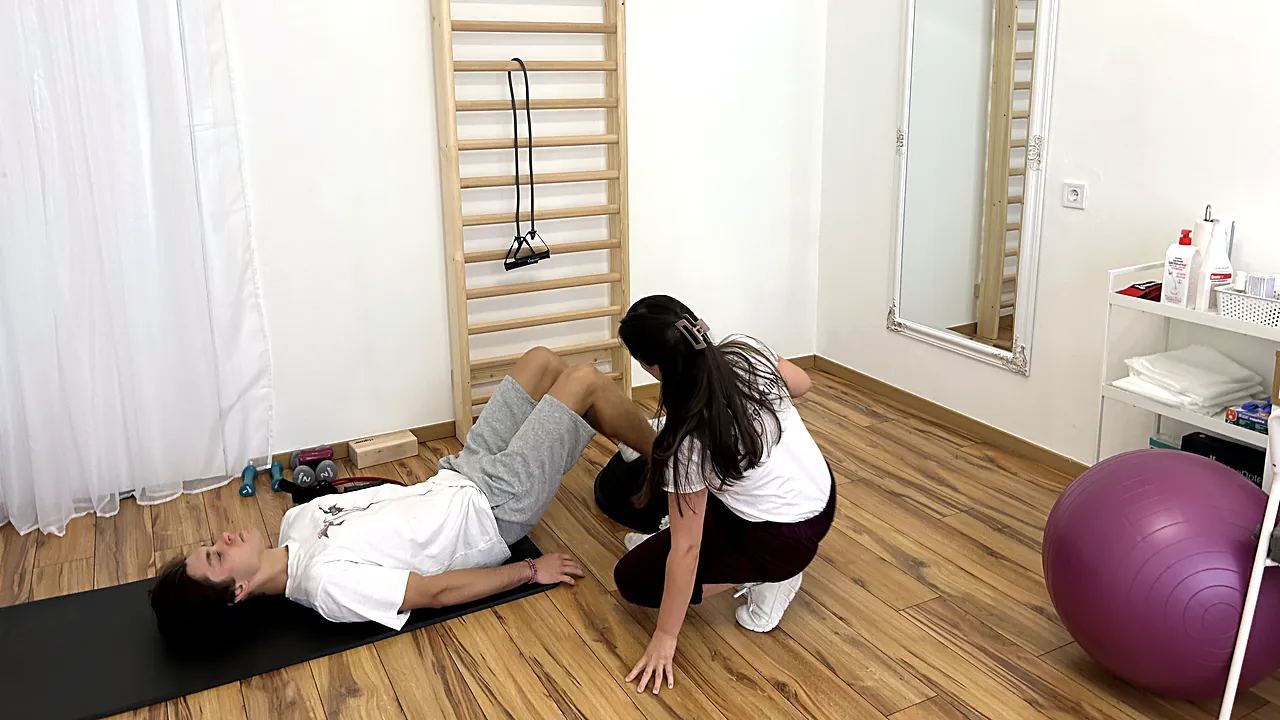
Your first appointment isn’t a chat followed by “we’ll start next week”. It works in three steps:
- We map out what’s going on – we ask questions, watch how you move, and use standardised manual and functional orthopaedic tests to find the source of the pain. If you have an MRI report, bring it.
- We build a treatment plan around you – based on the assessment, we place you on the MozgásPiramis® (the network’s five-level Movement Pyramid) and explain what to expect.
- Treatment starts at that same first visit.
We go into more detail in our article on your first assessment in Újlipótváros. Whether exercise or hands-on work takes the lead for you is decided during the assessment; if you’d like to know more beforehand, read what a physiotherapist in the 13th district does and what manual therapy involves.
Getting here fits easily around a working day. The M3 stops at Lehel tér and Nyugati pályaudvar are both close by (about 2–3 minutes on foot from the Lehel tér metro exit, about 8 from Nyugati pályaudvar), and if you drive you can park in the Westend underground car park and simply cross Váci út; a lift takes you up to the mezzanine floor. Prices are on our physiotherapy and manual therapy prices page, and you can call us on +36 30 790 6270.
If your back has been “manageable” for a while now, book a consultation (opens in a new tab) and let’s see where you actually are.
Why doesn’t treatment stop when the pain does?
Level 1 of the MozgásPiramis® is about relieving pain and improving circulation: finding which tissue or joint is causing the pain and working on it with manual therapy and exercise. The protocol the clinic uses for this level is 12 sessions, twice a week.
This is where many people slip up. Once the pain eases, they stop. In the clinic’s experience, this is the level where most people drop out, and stopping here makes it more likely the pain will come back. Being pain-free isn’t the same as your back being ready for everything your days ask of it. The higher levels build on that: joint range of motion, strength, functional stability and finally the return to full activity. Nobody can promise in advance how many sessions you’ll need or how fast you’ll move through them – that depends on how you respond.
The best moment for an assessment often isn’t your worst day. It’s the third time the same pain turns up. If that’s where you are, we’re on Váci út, a few steps from Westend. Book a consultation (opens in a new tab).
Frequently asked questions
Do I need a referral to come in with back pain?
No. As a private clinic, we see patients without a referral. If you’ve already seen a doctor, bring any reports or specialist opinions, as they’re useful for the assessment.
Do I need an MRI first?
Not necessarily. If you already have one, we’ll go through it at your first consultation. Whether imaging is needed is a doctor’s decision; if the assessment suggests it might be, we’ll tell you.
How can I pay, and will my insurance cover it?
You can pay by cash, bank card or SZÉP card (a Hungarian employee benefits card), and we can issue invoices for Hungarian health funds (egészségpénztár). Please note that we issue Hungarian invoices only, can’t complete forms for foreign insurers, and any reimbursement is your own responsibility. More in our article on paying with health funds and SZÉP card.
How many sessions until my back pain is gone?
Nobody can responsibly promise that up front. Level 1 is 12 sessions, twice a week, but how many you need and what comes after depends on your assessment and how you respond to treatment.