If your neck feels stiff by the end of a day in one of the offices along Váci út, and the ache creeps towards your shoulders, the usual culprit is long hours in one position in front of a screen – and it’s generally something that can be helped. Neck pain physiotherapy on Váci út can even fit into a lunch break: MozgásKlinika Újlipótváros is at Váci út 28, directly opposite Westend, between Lehel tér and Nyugati. Below: which signs to take seriously, what you can change at your desk today, and when it’s worth seeing a physiotherapist.
What does desk-related neck pain feel like?
It rarely starts with a bang. Nothing in the morning, then by 3 pm you’re rolling your head around trying to get it to “click”, and by the evening the tops of your shoulders are pulling too.
Typical signs of office neck pain (cervicalgia):
- stiffness, especially when turning your head – reversing the car, or when a colleague calls you from the next desk
- a dull, tight ache at the back of the neck that spreads towards the shoulders and between the shoulder blades
- pain that builds through the working day and eases off at the weekend
- sometimes a headache that starts at the base of the skull
The mechanism is simple enough. Your head drifts forward towards the monitor, the laptop sits too low, the mouse is too far away, your shoulders creep up towards your ears under deadline pressure, and on the metro you look down at your phone – all of it for hours, barely moving. It isn’t one “bad posture” that does the damage; it’s staying in the same position for too long.
Pain that travels down your arm, all the way into your fingers, is a different matter. More on that in the warning signs below.
What can you change at your desk today?
You don’t need new furniture to hurt less tomorrow. A few quick adjustments:
- Put the top edge of your monitor at roughly eye level, about an arm’s length away.
- On a laptop all day? Raise it on a stand and use a separate keyboard and mouse.
- Don’t wedge the phone between your ear and shoulder on calls – use a headset or speakerphone.
- Keep the mouse close, so you’re not reaching forward from the shoulder.
We’ve covered the full setup (chair, desk height, standing work) in a separate article: how to set up your office workstation.
Movement breaks between meetings
Even a good position gets tiring if it never changes. A couple of minutes of movement every hour can make a real difference. A few simple ones you can do at your desk:
Chin tuck: sitting tall, draw your chin straight back as if making a double chin, hold for a few seconds, then release.
Backward shoulder rolls and shoulder-blade squeeze: roll your shoulders slowly backwards, then draw your shoulder blades together and slightly down.
And the simplest one: stand up. Walk to the kitchen, get a glass of water, look out of the window at something far away. If any movement makes the pain worse or brings on numbness, stop and get it checked.
When to see a physiotherapist – and when to see a doctor
Don't wait if...
Get a medical check promptly if, alongside neck pain:
- your arm or hand goes numb or weak, or your grip becomes clumsy
- you have symptoms in both arms, or your walking has become unsteady
- the pain started after an accident, fall or impact
- it comes with fever, an unusually severe headache, dizziness, or problems with vision or speech
- it’s severe at night and at rest, and no position eases it
For sudden weakness, or problems with speech or vision, call 112.
The less dramatic case is the more common one: no warning signs, but the pain comes back every week, or doesn’t ease within a few days, and you’re starting to feel it beyond your neck. That’s a good time to see a physiotherapist, before it turns into a habit.
Where radiating symptoms come from isn’t always obvious. Tingling fingers can come from the neck, but also from the wrist – see our article on carpal tunnel syndrome. If it’s mostly your shoulder that hurts, have a look at our piece on shoulder pain. Which one applies to you is something an assessment decides, not a symptom list.
Book a consultation (opens in a new tab)
Neck pain physiotherapy on Váci út: what happens at the clinic?
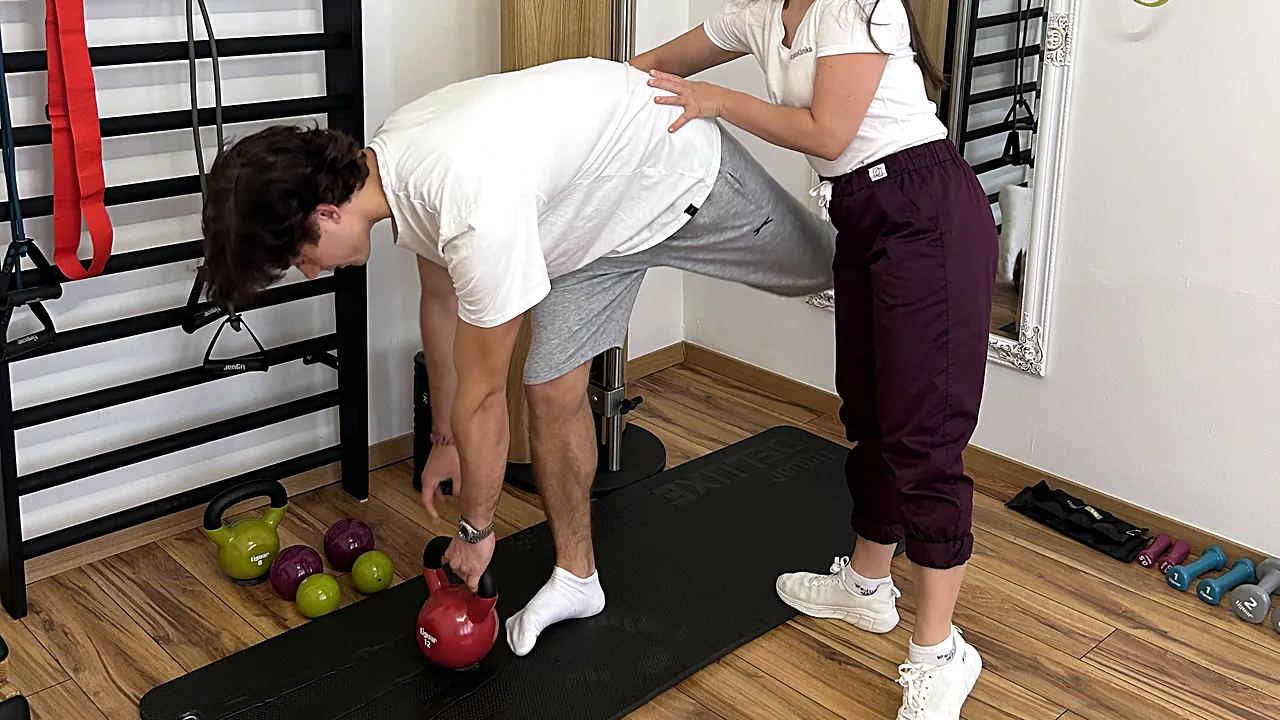
In Hungary you’ll often see physiotherapy called gyógytorna (therapeutic exercise) and hands-on treatment called manuálterápia (manual therapy); we use both. Treatment follows the MozgásPiramis® (Movement Pyramid) method. At the first level the aim is to ease pain and restore movement: with manual therapy we work on the neck joints and tight muscles, and with therapeutic exercise we strengthen the muscles that hold up your head and shoulder blades. The protocol for that first level is 12 sessions, twice a week – but nobody can promise in advance exactly how many you’ll need; that depends on how you progress. Where it’s useful, we may add supporting physical therapy such as kinesiology taping.
How it works with us:
- We map it out – we look at where the pain comes from, how your neck moves, and what a typical working day looks like for you.
- We tailor the treatment plan to you – based on the assessment, we put together your treatment and exercises you can do at home and at the office.
- We get started at your first visit – treatment begins in the same session as the assessment.
There’s more on what to expect in our article about your first assessment.
Book a consultation (opens in a new tab)
Lunch break or after work: does it really fit?
The clinic is at Váci út 28, on the mezzanine floor (félemelet), opposite Westend, near the DM drugstore on Váci út. If you work in one of the offices around Westend, it’s just a matter of crossing Váci út (about a 3-minute walk). A few steps, then a lift.
It’s easy from further afield too: both Lehel tér and Nyugati pályaudvar stations on the M3 metro line are close by, and trams 4 and 6 stop at Nyugati tér. If you drive, you can park in the Westend underground car park and walk across. Working on the other side of Nyugati, in the 5th district? We’ve written a guide for offices near Nyugati. Full directions are here: how to find us by Westend.
A physiotherapy session lasts 50 minutes and the first consultation 60. Whether early-morning or after-work slots are available depends on opening hours (Monday to Friday, 8:00–20:00). Questions? Call us on +36 30 790 6270. English-speaking patients are welcome.
Frequently asked questions
Can I fit a session into my lunch break?
If you work near Westend or along Váci út, usually yes. A session is 50 minutes, and the clinic is right opposite Westend, so travel time is short. Allow a bit more time for your first consultation.
My hand goes numb too. Is that coming from my neck?
It might be, but not necessarily: numbness can come from the neck or from a nerve at the wrist. If the numbness comes with weakness or clumsiness, see a doctor first. If there are no warning signs, the assessment will help work out where it’s coming from.
How many sessions will I need?
That can’t be guaranteed in advance. The first-level protocol is 12 sessions, twice a week, but the actual number depends on your complaint and how you progress. We’ll talk it through after your assessment.
Can I claim it on my insurance?
We issue Hungarian invoices only, including health-fund invoices for Hungarian health funds (egészségpénztár). We don’t fill in forms for foreign insurers or correspond with them, so claiming any reimbursement from a foreign insurer is up to you. Bring any previous scans (MRI, X-ray) to your first visit – reviewing them is part of the consultation.
Your neck won’t get better by “holding out until Friday”. A raised monitor and a few movement breaks can do a lot, but if the pain keeps coming back regardless, it’s worth finding out what’s keeping it going – and for that, you only need to cross Váci út.