Waking up at night with tingling fingers and shaking your hand to get the feeling back is one of the classic signs of carpal tunnel syndrome. At MozgásKlinika Újlipótváros (Váci út 28., opposite Westend), carpal tunnel syndrome treatment in Budapest’s 13th district starts with a proper assessment. If your symptoms suit conservative care, we continue with physiotherapy and manual therapy, and we coordinate with a doctor or neurologist whenever that’s the better route.
What does carpal tunnel syndrome feel like?
On the palm side of your wrist there’s a narrow channel, the carpal tunnel. The median nerve runs through it alongside several tendons. When pressure inside that space stays high for long periods, the nerve becomes irritated, and that’s what carpal tunnel syndrome is.
Typical symptoms include:
- numbness or pins and needles in the thumb, index and middle fingers, sometimes half of the ring finger
- waking at night or early morning with a numb hand, often relieved by shaking it out
- symptoms that build when your wrist stays bent: scrolling on your phone, driving, holding a book
- clumsiness, a weaker grip, dropping things – usually a later sign
If it’s mainly your little finger that goes numb, or the tingling starts in your neck and runs down your arm, a different nerve or a different level may be involved. That’s exactly why self-diagnosing from symptoms isn’t a good idea.
What might be behind it?
There’s rarely a single cause. Usually several things add up, and some of them aren’t in the hand at all.
Repetitive, sustained hand use
Plenty of people in the Váci út office buildings spend all day on a keyboard and mouse and assume the computer is to blame. Whether computer work on its own causes carpal tunnel syndrome is not clearly established. What’s more likely is that long hours with a bent or extended wrist, a tight grip on the mouse and no breaks can make existing symptoms worse. If that sounds familiar, have a look at our guide to setting up your desk in a Váci út office.
Forceful, repeated gripping and vibrating hand tools show up more in hands-on jobs – hairdressers, cooks, cleaners, craftspeople.
Pregnancy and the months after birth
During pregnancy the body holds on to more fluid, which can narrow the tunnel too, and many people first notice the numbness then. Then comes the lifting, the pushing of a pram down to Szent István park, the night feeds with a bent wrist. Your hands barely get a break.
Other health conditions
Diabetes, an underactive thyroid, inflammatory joint conditions or an old wrist fracture can all make it more likely. A physiotherapist doesn’t treat these, but we need to know about them during the assessment.
Things that look similar but aren’t
Nerve root irritation coming from the neck, or a nerve trapped at the elbow, can cause very similar tingling. If your neck aches after long days at the desk as well, our article on office neck pain along Váci út is worth a read.
If your hand has been going numb for a while and you’d like to know where it’s really coming from, Book a consultation (opens in a new tab).
When should you see a doctor, and when is surgery an option?
Don't wait – see a doctor or neurologist if
- the numbness has become constant and doesn’t ease during the day
- the muscle pad at the base of your thumb looks flatter or wasted
- your grip is getting weaker and you keep dropping things
- the symptoms started after a fall or wrist injury
- both hands, or your feet too, go numb, or you notice other neurological symptoms
If you suddenly develop arm or hand weakness, facial numbness or slurred speech, call 112 immediately.
An accurate diagnosis often needs a nerve conduction study (called ENG in Hungary), which a doctor orders. In severe cases, or when conservative treatment doesn’t help, surgical release of the carpal tunnel may be considered, and that decision belongs to a hand surgeon or orthopaedic specialist. If we see signs like these at your assessment, we refer you to a doctor first and plan treatment afterwards.
Carpal tunnel syndrome treatment in the 13th district: what can physio and manual therapy do?
For mild to moderate symptoms, conservative treatment is often the first step. The aim is to calm the nerve down and gradually rebuild how much load your hand can take. We won’t promise a quick fix, but we will look carefully at what’s keeping the problem going.
Manual therapy for the wrist and arm
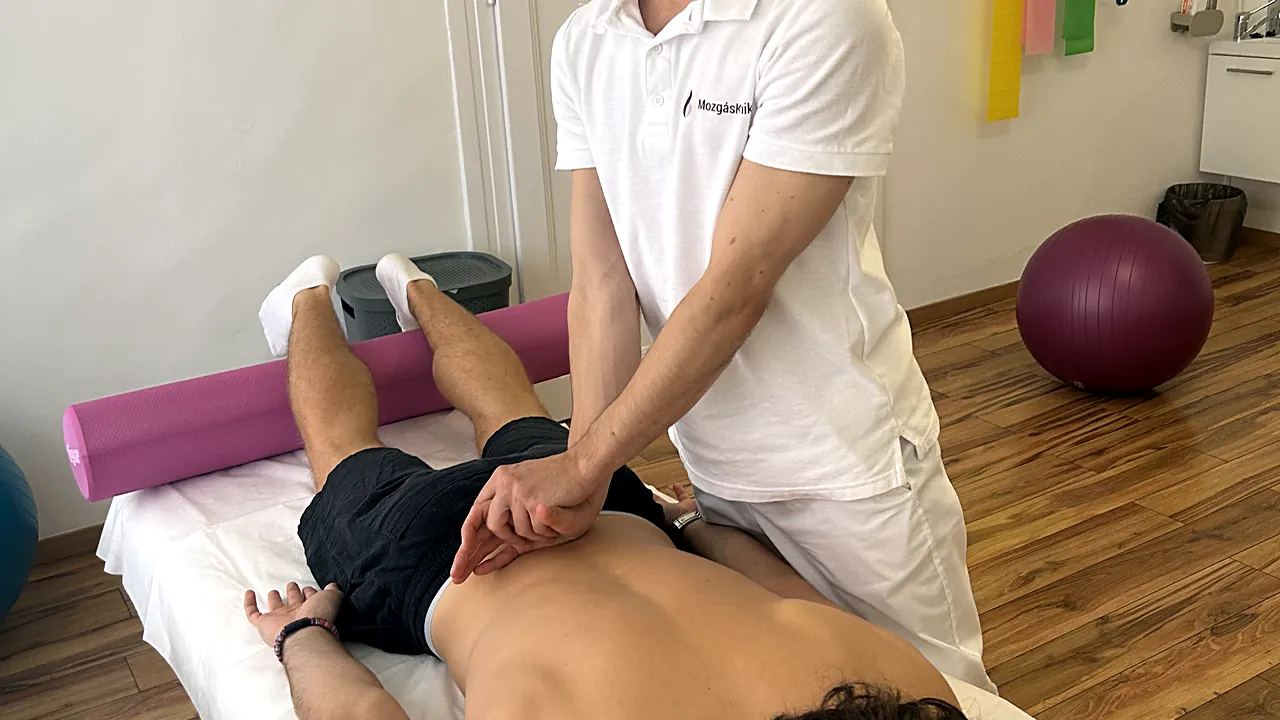
Manual therapy (manuálterápia) means hands-on treatment. Your therapist may mobilise the small wrist bones, work on tight soft tissue around the wrist and forearm, and check your neck and shoulder too, since that’s where the nerve’s path begins. Read more about how we approach it in our article on manual therapy in Újlipótváros.
Physiotherapy: nerve and tendon gliding
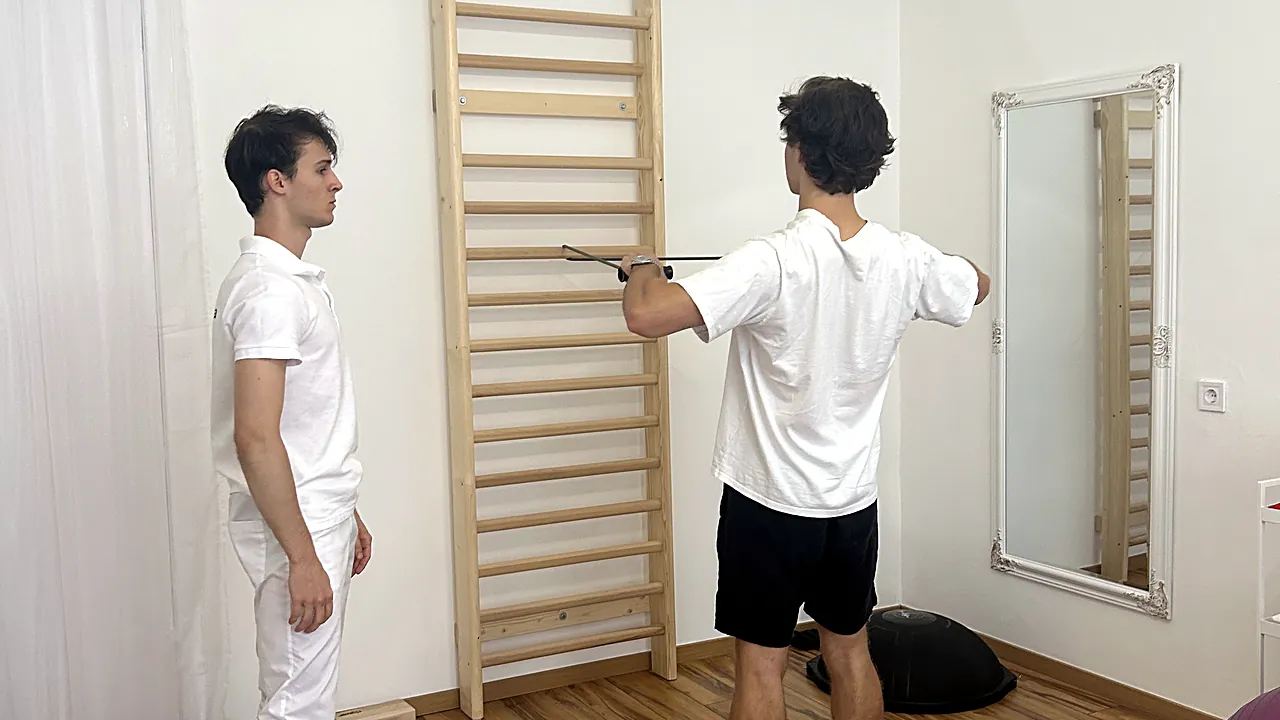
In Hungary, therapeutic exercise with a physiotherapist is called gyógytorna. For carpal tunnel it usually includes exercises that help the nerve and tendons glide (nerve mobilisation), gradual grip strengthening and changes to the everyday movements that aggravate it. You’ll also get a short home programme you can do during breaks at work. To see who you’d be working with, read about finding a physiotherapist in the 13th district.
Night splints and small changes
A night splint that keeps the wrist in a neutral position helps many people, and we’ll talk through whether it suits you after the assessment. Sleeping position, the height of your mouse and keyboard and how you hold your phone matter too. Small things, but you repeat them thousands of times a day. Physical therapy modalities may be added.
How long does it take? MozgásKlinika’s own protocol for the first, pain-relief stage is typically a 12-session programme, twice a week. How many sessions you’ll actually need can’t be guaranteed in advance – everyone responds differently.
If you’d like to see what conservative treatment can do for you, Book a consultation (opens in a new tab).
How does the assessment work at our Váci út clinic?
The clinic is on the mezzanine floor of Váci út 28., between Lehel tér and Nyugati, opposite Westend and near the DM store. The M3 metro stops at Lehel tér and Nyugati pályaudvar are both nearby (about 2–3 minutes on foot from the Lehel tér metro exit, about 8 from Nyugati pályaudvar), and trams 4 and 6 stop at Nyugati tér. If you drive, park in the Westend underground car park and cross Váci út; a few steps, then a lift takes you up. Full directions: how to find us on Váci út. (Monday to Friday, 8:00–20:00)
Your first visit has three steps:
- We map out the problem – we ask when and how the symptoms show up, about your work and how you use your hands, then test your wrist, strength, sensation and the nerve’s path from neck to fingertips. Bring any previous results (nerve conduction study, ultrasound, discharge notes).
- We build a treatment plan around you – using the MozgásPiramis® method we work out where you are and what comes next, or refer you to a doctor if needed.
- We start treatment in that same first session – the assessment isn’t a separate, hands-off appointment. You leave with treatment already begun and exercises to take home.
There’s more detail in our article on your first assessment in Újlipótváros, and current fees are on our prices page.
Frequently asked questions
Can carpal tunnel syndrome go away on its own?
Sometimes, especially when it’s mild and linked to a temporary state such as pregnancy. If it’s lasted for weeks, is getting worse, or your grip is weakening, don’t wait it out.
Do I need a referral?
As a private clinic we see patients without a referral. If a doctor has already examined you, bring your results along – they help with the assessment.
How can I pay, and will my insurance cover it?
You can pay by cash, bank card or SZÉP card, and we issue invoices for Hungarian health funds (egészségpénztár), most of which we’re contracted with. Please note that we issue Hungarian invoices only, we can’t fill in forms for foreign insurers, and claiming reimbursement is your own responsibility. More in our article on health funds and SZÉP cards.
I’ve already had surgery. Can physio still help?
Rehabilitation after injury and surgery is one of the clinic’s core services. After carpal tunnel release, we can help you rebuild load gradually and work on the scar area, in line with your surgeon’s instructions.
A numb hand is rarely an emergency, but getting used to it won’t make it go away. Whether you work on Váci út, live in Újlipótváros or just pass through Nyugati, one assessment will show you the next step – treatment with us or a visit to a doctor. Call us on +36 30 790 6270, or Book a consultation (opens in a new tab).