If your knee has started to ache after laps of Margitsziget (Margaret Island) or runs along the Danube, runner’s knee treatment rarely begins with giving up running altogether. It starts with finding out what is overloading the joint. MozgásKlinika Újlipótváros, at Váci út 28 opposite Westend, helps runners get back to their usual routes with sports-specific physiotherapy and manual therapy, a short hop from the island.
This one is for people who circle the island several times a week, head down to the river from a flat in Újlipótváros, or squeeze in a run after a day in one of the Váci út offices.
What does “runner’s knee” actually mean?
Runner’s knee is an umbrella term, not a single diagnosis. Most often it describes pain at the front of the knee, around or behind the kneecap (patellofemoral pain syndrome). Runners also use the same name for a sharp pain on the outside of the knee, linked to irritation of the iliotibial band (ITB syndrome).
They are different problems, and they are treated differently. That is why guessing from an online description tends to go wrong.
Signs runners often come in with:
- a dull ache around or behind the kneecap, especially going downstairs or squatting
- a stiff, sore knee after sitting for a long time – the end of a film, or a long meeting
- pain on the outer side of the knee that starts at a certain point in the run and then won’t settle
- pain running downhill, while flat ground still feels manageable
What sets it off?
There is rarely one single cause. Usually several small things add up until the knee complains.
Doing too much, too soon
A burst of spring motivation, an upcoming half marathon, or just “one more lap of the island”. Your fitness improves faster than your tendons and joint cartilage adapt to the load, and the knee is often the first place you feel that gap.
Weak hip and thigh muscles
If your glutes (especially the muscles that steady the hip from the side) and your quadriceps can’t handle the load, the knee may drift inwards slightly with each stride. You won’t notice it mid-run, but over thousands of steps it adds up.
Shoes and surface
Worn-out shoes, or a sudden switch to a very different type of shoe, can play a part. So can hills and steps – many runners only feel the pain there.
Long days at a desk
Plenty of people in the Váci út office buildings sit for eight hours, then go straight into a tempo run in the evening. Sitting doesn’t cause runner’s knee on its own, but stiff hips and cold thighs are not the best starting point.
If this sounds familiar, there’s no need to wait until the pain shows up on everyday stairs too. Book a consultation (opens in a new tab) and we’ll work out what’s behind it.
When not to wait: warning signs
Don’t test it on your next run – see a doctor or orthopaedic specialist if:
- the knee swells up quickly and visibly,
- it locks or catches, and you can’t fully straighten or bend it,
- it gives way under you,
- the pain started after a fall, twist or awkward landing and you can’t put weight on it,
- the knee is hot and red and you have a fever.
Locking and giving way, for example, can also point to a meniscus injury – our article on physiotherapy after a meniscus injury covers this in more detail.
Why stopping completely isn’t always the answer
Many runners’ first instinct is to stop for weeks. Rest can calm the pain, but if nothing else changes – same hip strength, same shoes, same sudden return to your old laps – the problem is often waiting exactly where you left it.
The better aim is usually managing the load sensibly: shorter distances, an easier pace, skipping the painful hills for a while, plus targeted strengthening alongside. What that means for you, and whether you can keep running during treatment at all, is something we can only tell you after the assessment.
Runner’s knee treatment with sports physiotherapy on Váci út
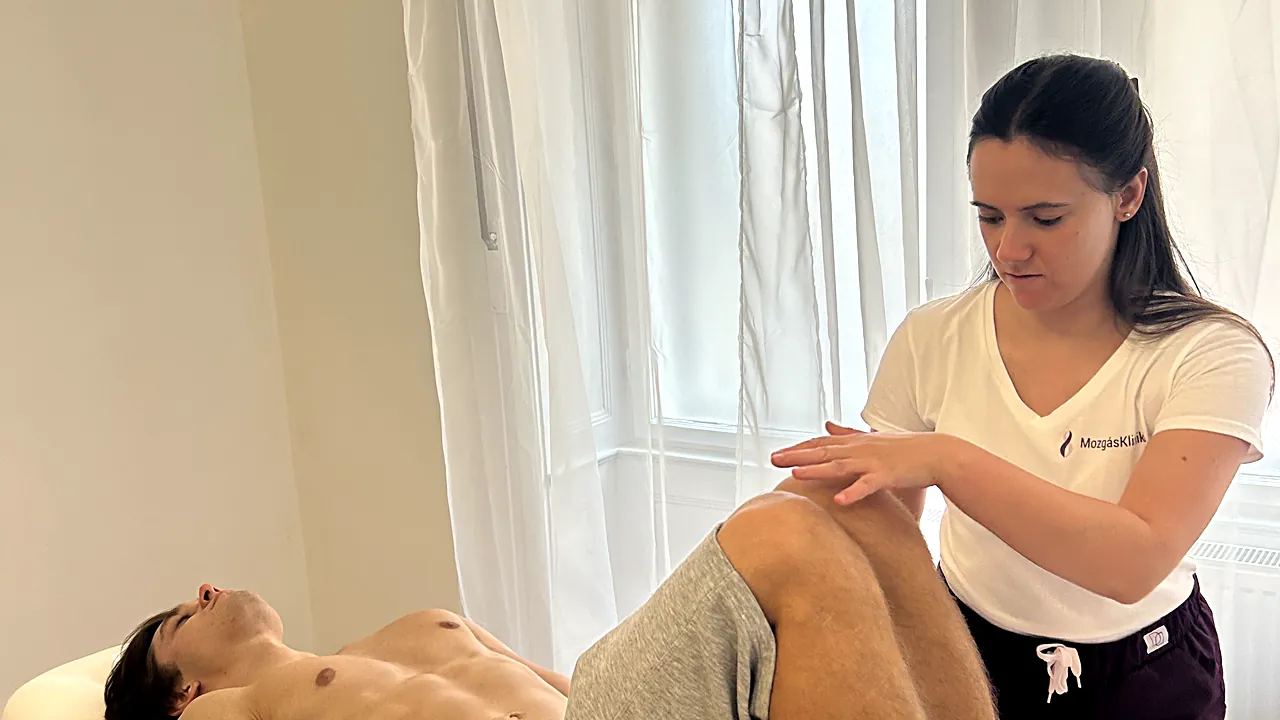
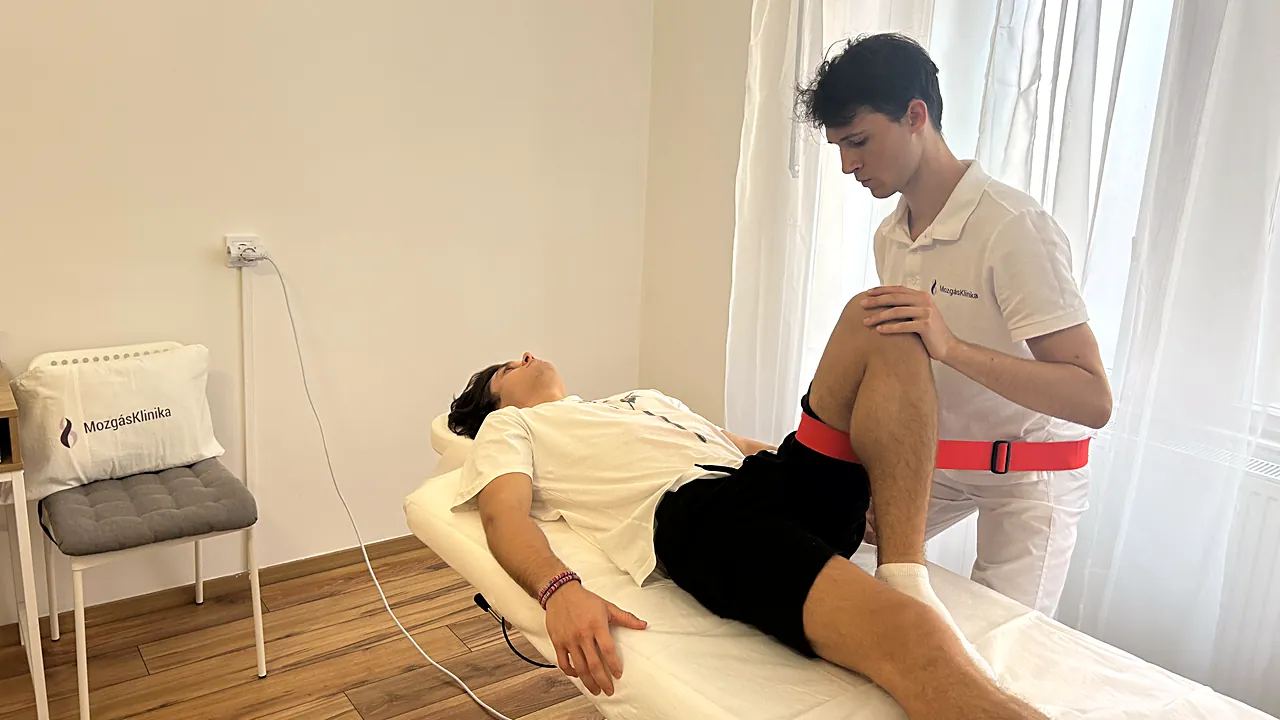
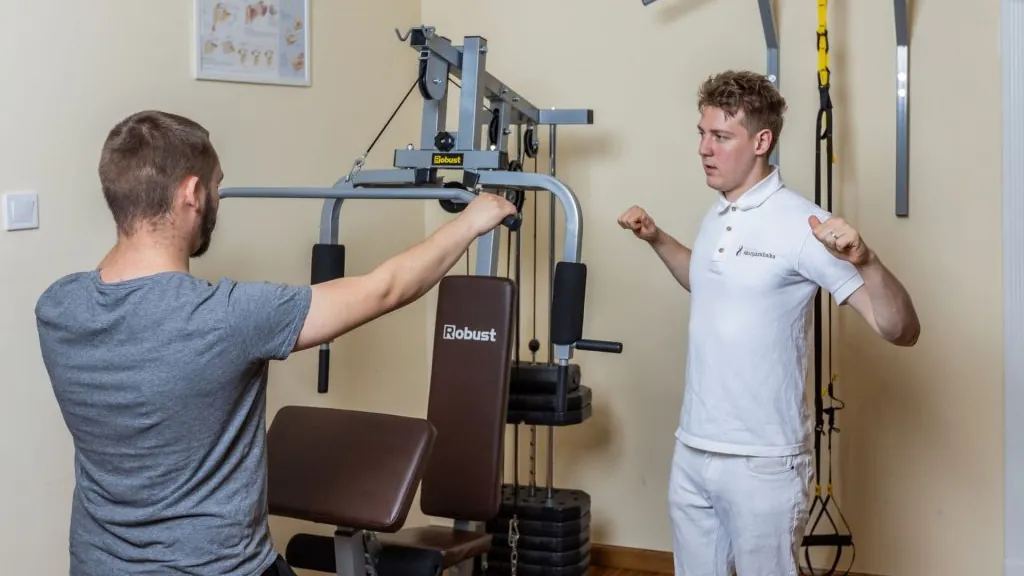
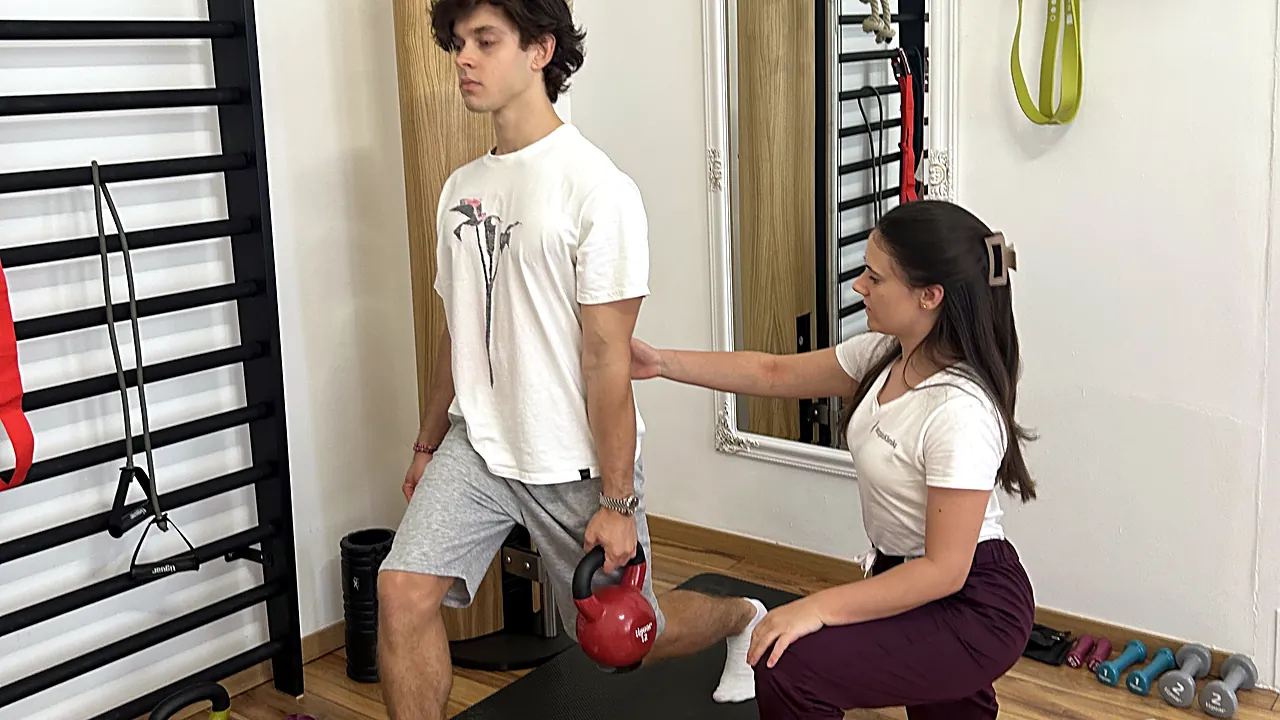
Treatment starts with a thorough first visit. We ask about your training: how much you run, what has changed recently, what shoes and what surfaces. We watch how you squat, how you load the knee on one leg, and how strong your hips are. Our article on what happens at your first assessment goes through the visit step by step.
The treatment is built around sports-specific physiotherapy – in Hungarian, gyógytorna, meaning physiotherapy based on therapeutic exercise – with manual therapy (manuálterápia, hands-on treatment of joints and soft tissue) added where needed to ease the pain. The exercises target the weak link, which in runners is very often the hip. Towards the end, we plan your comeback together: when, how far and how fast you can run the island again.
At the first level of the MozgásPiramis® method, the network’s protocol is 12 sessions, twice a week. Nobody can promise in advance how many sessions you’ll actually need – that depends on how your body responds. At the Újlipótváros clinic sport-specific exercise is part of physiotherapy (gyógytorna); there is no separate Sports Rehabilitation pass here, but you can choose a Spine Memo or Spine Therapy pass. Current fees are on our physiotherapy and manual therapy prices page. Payment is by cash, card or SZÉP card. Please note: we issue Hungarian invoices only and can’t complete forms for foreign insurers, so any reimbursement is your own responsibility.
If it’s more than a sore knee – a proper injury – have a look at our piece on sports injury rehabilitation for Margitsziget runners. And if your heel hurts first thing in the morning, the article on heel spur treatment may help.
How we work
- We map it out – we talk through your training and use movement tests to find where the knee pain comes from.
- We tailor the treatment plan to you – around your running goals and your weekly routine.
- We get started at the very first visit – treatment begins in the same session as the assessment.
The clinic is on Váci út, between Lehel tér and Nyugati. You can park in the Westend underground car park and just cross Váci út; the M3 metro stops Lehel tér and Nyugati pályaudvar, and trams 4 and 6, are all close by. It’s about 25–30 minutes on foot from Margitsziget and about 11 minutes from Szent István park. (Monday to Friday, 8:00–20:00)
Book a consultation (opens in a new tab) – or call +36 30 790 6270.
Frequently asked questions
Can I keep running while I’m in treatment?
Often yes, at a reduced distance and pace – but we decide that after the assessment, not beforehand. Some people need a few weeks off, others can carry on with shorter loops.
Should I bring my running shoes?
It’s a good idea. Wear and shoe type tell us a lot, and the movement tests are easier in sportswear.
How many sessions does runner’s knee take?
That can’t be guaranteed in advance. The first-level protocol is 12 sessions twice a week, but the real number depends on the assessment and how your knee responds.
Do you speak English?
Yes, English is spoken at the clinic. Just mention it when you book.
The point isn’t to give up your island laps; it’s to keep running them without pain, so that at your next race you’re thinking about your split times rather than your knee. Once you’re through treatment and want to keep strengthening under professional supervision, Medical Fitness on Váci út is designed for exactly that. Book a consultation (opens in a new tab) and we’ll start with the assessment.