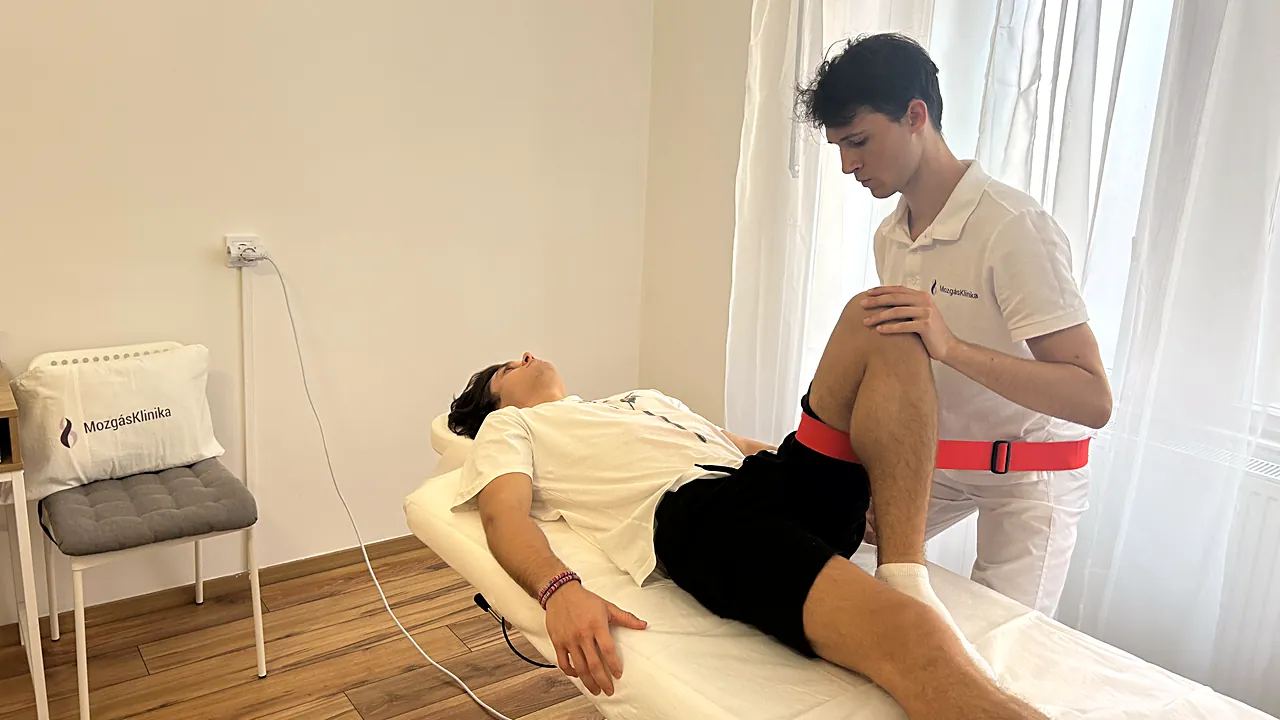
If your knees, hips or shoulders have started to ache as you get older, targeted physiotherapy can help you move with more confidence and less pain. For physiotherapy for older adults in the 13th district (XIII. kerület), MozgásKlinika Újlipótváros is at Váci út 28, opposite Westend: we start with a proper assessment, build a plan around you, and begin treatment in that same first session. This article is for you, and for anyone looking for a good physiotherapist for a parent living nearby.
In Hungarian, what we do is called gyógytorna – physiotherapy built around therapeutic exercise – often combined with manuálterápia, or manual therapy.
Why keep moving when it hurts?
Most of us grew up with the idea that a sore joint needs rest. For a short while, that can be right.
Over months, though, avoiding movement tends to feed on itself. The joint you protect gets stiffer, the muscles around it lose strength, weaker muscles give the joint less support, and every flight of stairs or trip to the shops starts to feel a little harder than the last one.
Joints and muscles respond to well-judged loading at any age. You don’t need a gym or a fitness goal. The aims are everyday ones: stepping onto the tram without a second thought, bending down to a grandchild, or walking the length of Szent István park comfortably.
Knees, hips and shoulders: the usual suspects
Knee pain in older age
Your knees carry your body weight with every step, so it’s often the first place people notice change. Typical signs are stiffness first thing in the morning, pain going down stairs, and needing a few steps to “get going” after sitting for a while. Wear of the joint cartilage – porckopás in Hungarian, osteoarthritis in medical terms – is a common cause, but not the only one. Weak muscles, an old injury or a meniscus problem can feel very similar. If the pain started after a twisting movement, have a look at our article on meniscus injuries.
Hip pain
Hip trouble doesn’t always show up where you’d expect. You might feel it in the groin, the front of the thigh or the buttock. Putting socks on, getting into a car or lying on your side at night can all become awkward.
Shoulder pain
This one usually creeps up. One day it’s harder to reach the mug on the top shelf, or getting into a coat hurts. The shoulder is one of the most mobile joints in the body, so protecting it too much can lead to lost range of movement surprisingly quickly.
When to see a doctor first
Physiotherapy helps with many joint problems, but some signs need a medical check first. Don’t wait if:
- a joint suddenly swells, turns red or feels hot, or you also have a fever;
- you’ve had a fall and can’t put weight on your leg, or the joint looks misshapen;
- the pain is severe at night or at rest, doesn’t change with movement, or comes with unexplained weight loss;
- after joint replacement surgery, the wound is red or weeping, or your calf is tight, swollen and painful.
If none of these apply but the pain has been getting in the way of daily life for weeks, it’s worth having a physiotherapist take a look. Book a consultation (opens in a new tab)
What can physiotherapy do for joint pain?
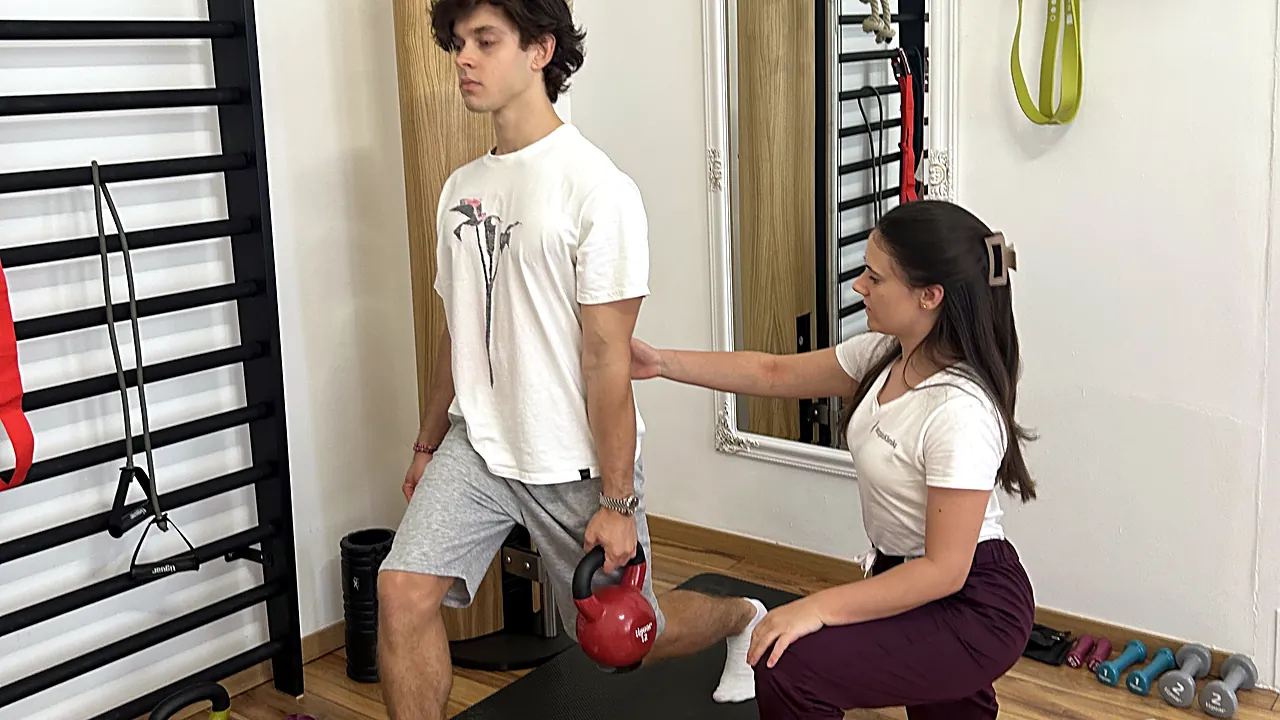
Treatment here is one-to-one and tailored, not a one-size-fits-all group class. We focus on four things. Range of movement, so the joint gives you more room again. Strength, because stronger thigh and hip muscles can take load off the knee and hip. Balance, the foundation of steady walking. And confidence: knowing what’s safe and useful to do at home.
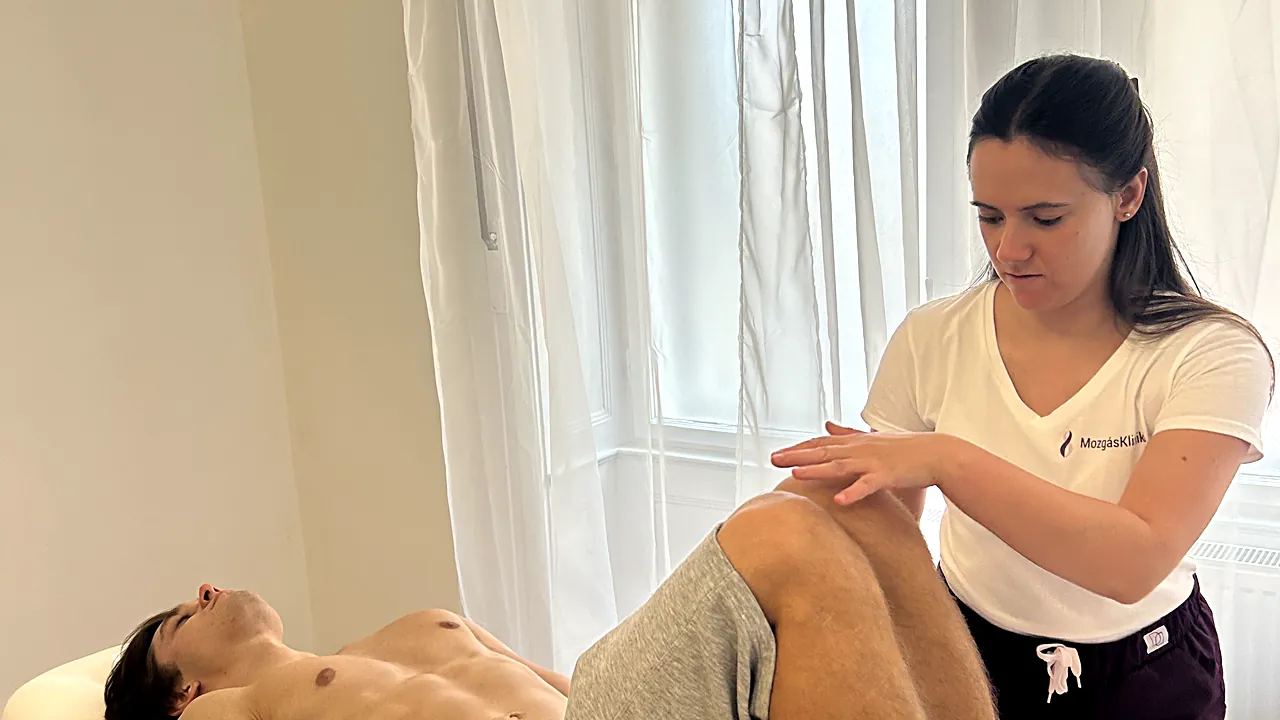
Where it helps, we combine exercise with manual therapy – hands-on techniques that can ease pain and improve how the joint moves, so the exercises become easier to do. Our work follows the MozgásPiramis® (Movement Pyramid) method, which progresses from pain relief through joint range of motion and strength to functional stability and full activity. You can read more about our physiotherapists and how they work.
Rehab after knee or hip replacement
Rehabilitation after joint replacement is one of the areas the clinic treats. Plenty of people get home from hospital and feel a bit left to it: the wound is healing, but stairs, weaning off crutches and walking confidently are still ahead. Physiotherapy can help you gradually regain movement and leg strength, always in line with your surgeon’s instructions. Bring your hospital discharge summary and any exercise guidance you were given.
MozgásKlinika’s own protocol for the first stage is twice a week, 12 sessions in total, but nobody can promise in advance exactly how many sessions you’ll need. That depends on your assessment and how you respond. Book a consultation (opens in a new tab)
What happens at the first visit?
We take things at a gentle pace. We sit down and talk before any testing. If you’re coming with a parent, you’re welcome too. There’s a detailed guide to the first assessment here.
- We map out the problem – we go through your symptoms, past illnesses, operations and medication, then use the MozgásPiramis® assessment and orthopaedic tests to find where the pain is likely coming from.
- We tailor the treatment plan to you – built around your goals, whether that’s managing stairs, longer walks or the first weeks after a replacement.
- We get started in the first session – the assessment isn’t a separate talking-only appointment; treatment begins in the same hour.
Bring comfortable clothes, any previous results (X-ray, MRI, discharge summary) and a list of your medication. You can pay by cash, bank card or SZÉP card, and health-fund invoices are available – see our article on health funds and SZÉP cards. Please note that we issue Hungarian invoices only and can’t fill in forms for foreign insurers; claiming any reimbursement is up to you.
Getting to us on Váci út
The clinic is on the mezzanine floor (félemelet) of Váci út 28, between Lehel tér and Nyugati, opposite Westend and close to the DM on Váci út. From the entrance there are a few steps up to the lift. If you use a walker or crutches, give us a ring beforehand and we’ll talk through the easiest way in.
By car, the simplest option is the Westend underground car park, then a short crossing of Váci út (500 HUF per hour with the Westend app). By public transport, you’re close to the M3 metro at Lehel tér and Nyugati pályaudvar, and trams 4 and 6 at Nyugati tér (about 2–3 minutes on foot from the Lehel tér metro exit, about 8 from Nyugati pályaudvar). We’ve written up step-by-step directions here. If you live around Pozsonyi út or Szent István park, this article is written with you in mind.
Finishing treatment doesn’t mean stopping. Medical Fitness – supervised exercise with a healthcare professional – can help you hold on to the progress you’ve made.
You don’t have to work out on your own how much movement is right for your joints. Call us on +36 30 790 6270 or book online; if you’re arranging it for a parent, we’re happy to speak with you directly. Book a consultation (opens in a new tab)
Frequently asked questions
Do I need a doctor’s referral?
No. As a private clinic we see patients without a referral, but recent medical results or a discharge summary are helpful, so please bring them.
Is physiotherapy still worthwhile over 80?
Yes, age on its own isn’t a barrier. We always adjust the exercises and load to your condition, and if something isn’t right for you, we’ll say so honestly after the assessment.
When can I start after a joint replacement?
Your surgeon and your hospital discharge summary decide that. Bring the instructions you were given and we’ll work within them.
Do you work with English speakers?
Yes, English is spoken at the clinic. If English is easier for you or your parent, mention it when you book so we can plan accordingly.