Three everyday things do the most for your child’s posture: a well-chosen, lightly packed school bag worn on both shoulders, regular breaks from the screen, and plenty of varied movement after school. If their posture still worries you (one shoulder looks higher, or their back keeps hurting), have a professional take a look. MozgásKlinika Újlipótváros is at Váci út 28 in Budapest’s 13th district (XIII. kerület), opposite Westend, and we can also help you work out who the right person to see is.
A quick note on terms: in Hungary, gyógytorna is physiotherapy built around therapeutic exercise, and a gyógytornász is the physiotherapist who delivers it.
School bags travel a lot round here. Plenty of children in Újlipótváros and Angyalföld walk, take the tram or ride the M3 to school, so the backpack stays on through the packed 4 or 6 tram, the metro stairs and afternoon training.
Choosing and packing a school bag
When you buy one
- Two wide, padded shoulder straps. A single-strap bag hanging off one side puts the whole load on one shoulder.
- A padded, structured back panel, so the corners of textbooks don’t dig in.
- A chest or hip strap that stops the bag swinging around as they walk.
- A bag that fits your child now. Don’t buy one they’ll “grow into”: a bigger bag gets filled with more, and it sits lower on the back.
Get them to try it on in the shop, ideally with something in it. Comfortable empty isn’t the same as comfortable with a full set of books.
When they pack it
Heaviest things (textbooks, a laptop) go closest to the back. Go through the bag together most evenings: an empty water bottle, last week’s workbook, two pencil cases and forgotten trainers add up fast, and children rarely clear their bags out on their own. If the school lets pupils leave books there, make use of it.
We’re deliberately not giving a weight limit. Rules of thumb based on body weight exist, but what’s realistic depends on your child’s age, build and how far they walk with the bag. Watch for the signs instead. If your child leans well forward under the bag, complains about their shoulders, or has red marks where the straps sit, it’s too heavy for them.
When they wear it
On both shoulders, with the straps pulled snug, so the bag sits on the upper back rather than bouncing off their bottom. One shoulder looks cooler, of course. Good luck talking a twelve-year-old out of that, though trying both ways together in front of a mirror often works better than a lecture.
A wheeled bag can work on flat ground. In Újlipótváros, with metro stairs, tram steps and older buildings without a lift, it often ends up carried anyway.
If you’ve already noticed something you don’t like, don’t wait for it to sort itself out. Book a consultation (opens in a new tab), or call first to ask whether it’s something we can help with.
Screens, desks and movement matter just as much
The school bag goes on a few times a day. Phones, tablets and homework get hours, usually with the head bent down. You don’t have to confiscate anything. Raise the screen towards eye level (a tablet stand or a few books will do), and get them into the habit of standing up and moving at the end of each video or task.
For homework, aim for feet flat on the floor (or on a footrest if they don’t reach), a desk at roughly elbow height, and a chair that isn’t sized for an adult. Our guide to office ergonomics covers adult set-ups, and nights count too: see sleeping in a spine-friendly way.
Movement matters most. A child’s back doesn’t need one “correct” position so much as lots of movement, of lots of kinds: running, climbing, swimming, ball games, hanging off the climbing frame, all of which work the back, tummy and shoulder muscles without anyone calling it exercise. Szent István park and Margitsziget’s running track and lawns are close to most homes in Újlipótváros. If your child plays sport seriously and gets injured, see our article on sports injury rehabilitation near Margitsziget.
Children’s posture in the 13th district: when to see a professional
Not every slouch needs a diagnosis. Some signs, though, are worth having checked:
- one shoulder is visibly higher than the other,
- one shoulder blade sticks out more than the other,
- the waistline looks different on each side, or the hips look uneven,
- the head and shoulders stay pushed forward even after you remind them,
- back pain that keeps coming back, or doesn’t go away with rest.
You can check at home: after a bath, stand behind your child and see whether their shoulders, shoulder blades and waistline look even. If they bend forward with arms hanging down and one side of the back looks higher, show your paediatrician, as a sideways curve of the spine (scoliosis) could be behind it.
When not to wait: see a doctor
Take your child to the paediatrician, or to out-of-hours care if it’s urgent, if their back pain:
- wakes them at night, or is severe even at rest,
- comes with a fever, weight loss or unusual tiredness,
- started after a fall, a knock or a sports accident,
- comes with numbness or weakness in the legs, or a change in how they walk,
- comes with problems passing urine or stools,
- gets worse rather than better after a few days of taking it easy.
What we can do at MozgásKlinika Újlipótváros
For children, call us first
The MozgásKlinika network also works with children’s spine and posture problems. Before you book for your child, call us on +36 30 790 6270: based on their age and complaint, we’ll tell you whether we can help here or where you’d be better off going.
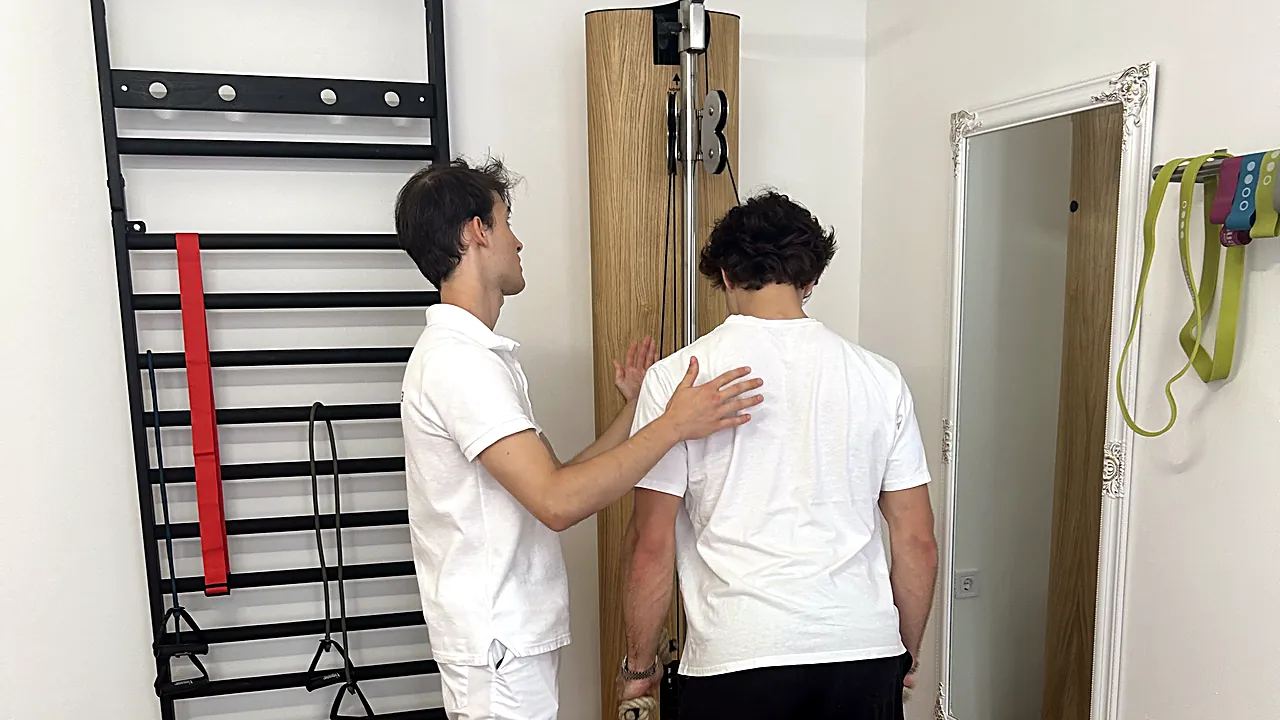
Physiotherapy for a child’s posture problem starts with a proper assessment, not a list of exercises. Not sure we’re the right place? Phone us. We’ll tell you honestly whether our clinic fits, or whether a paediatrician, a paediatric orthopaedic specialist or a children’s physio would be a better first stop.
If you start with us, we map out your child’s posture, movement and symptoms with standard checks, build a treatment plan around them (their age, school day and sport), and get started in the very first session, so the assessment isn’t an “empty” appointment. More on that in your first assessment in Újlipótváros. Nobody can promise a set number of sessions; that depends on how your child progresses.
With children, the parent is part of the team. Exercises only become habits at home, so it helps if you come along, at least at first. For when it’s worth seeing a physio in general, see finding a physiotherapist in the 13th district.
Book a consultation (opens in a new tab), or ask us first whether your child’s problem is one we can take on.
After school, on Váci út
The clinic sits between the Lehel tér and Nyugati pályaudvar stops on the M3, with trams 4 and 6 at Nyugati tér. Drivers can park in the Westend underground car park and cross Váci út; inside, a few steps lead to a lift. (Monday to Friday, 8:00–20:00) Full directions are in our guide to finding us by Westend on Váci út.
Good posture isn’t an exam your child passes once. It’s lots of small decisions: which bag goes in the basket, where the tablet sits, what they do between four and six in the afternoon. If you’d like a professional eye on any of it, call us on +36 30 790 6270 or book a consultation (opens in a new tab).
Frequently asked questions
Can a heavy school bag cause scoliosis?
A bag that’s too heavy or worn badly typically causes back and shoulder pain, but it isn’t considered a cause of scoliosis. If you notice any unevenness, get it checked whatever the cause.
Is a wheeled school bag a better choice?
On flat ground it takes the load off the back, but on stairs and public transport it gets carried in one hand, loading one side. With lots of stairs on the route, a well-adjusted backpack on both shoulders is often more practical.
Do you treat children at the Újlipótváros clinic?
The MozgásKlinika network does work with children, but please give us a call first. Tell us your child’s age and what’s bothering them, and we’ll say whether we can help or where you’d be better off going.
How do we get to you after school?
Take the M3 to Lehel tér or Nyugati pályaudvar, or trams 4 or 6 to Nyugati tér. By car, use the Westend underground car park; the clinic is directly opposite on Váci út.