If the outside of your elbow twinges when you pick up a mug, shake someone’s hand or spend the day on a mouse, you may well have tennis elbow – even if you’ve never held a racket. At MozgásKlinika Újlipótváros, Váci út 28, directly opposite Westend, tennis elbow treatment in the 13th district (XIII. kerület) means manual therapy and targeted physiotherapy: we work out what is overloading your forearm, and treatment starts at your very first visit.
What is tennis elbow, and how do you recognise it?
Tennis elbow (lateral epicondylitis) is an overload problem in the tendon of the forearm muscles that attach to the bony bump on the outside of the elbow. Those muscles pull your wrist and fingers back, and they work hard every time you grip something firmly. When a tendon is asked, week after week, to handle more than it can recover from, it starts to hurt.
Common signs:
- pain on the outer elbow, sometimes spreading down the forearm,
- it hurts to lift a full mug, press a door handle, shake hands or open a jar,
- your grip feels weaker and things occasionally slip out of your hand,
- one specific spot on the outer bony bump is tender to press.
Golfer’s elbow (medial epicondylitis) is the same kind of problem on the inner side of the elbow, where the wrist-bending muscles attach. The triggers and the treatment approach are very similar, so most of what follows applies to it too.
Why does your elbow hurt if you don’t play tennis?
The name is misleading. Most of the time the problem builds slowly, over weeks, out of ordinary repetitive gripping and lifting.
Mouse, keyboard, laptop
Plenty of people in the office buildings along Váci út, across from Westend, spend eight to ten hours a day on a mouse. The wrist is tilted slightly up, the fingers never stop, and the elbow often hangs unsupported. Each movement is tiny. Thousands of repetitions a day are not. We’ve written separately about desk ergonomics for Váci út offices.
Gripping and lifting at work
Hairdressers, chefs, mechanics, parents of small children – anyone who grips, twists or lifts all day.
DIY and weekend projects
A weekend of flat-pack furniture, painting or screwdriver work, and on Monday you can’t hold your coffee properly. The load is unusual and long, and the tendon simply isn’t used to it.
Carrying the shopping
Heavy bags carried home with a bent arm from Westend or the Lehel Market also load the forearm muscles. Once, it’s nothing. Several times a week for years is a different story.
Racket sports on Margitsziget
Tennis can of course cause it too, especially if you suddenly play much more, or if a technique issue means your forearm does the work your shoulder and trunk should be doing. If you play sport on Margaret Island and are coming back from an injury, our article on sports injury rehabilitation near Margitsziget is worth a read.
If the pain comes with numbness or tingling in your fingers, that points more towards a nerve problem – see our article on carpal tunnel syndrome.
When to see a doctor straight away
- The pain started after a fall or a blow, and the elbow is swollen, looks deformed or won’t move.
- The elbow is red, hot and swollen, or you have a fever.
- You have persistent numbness or loss of strength in your hand.
- The pain is severe at rest and at night, and getting worse day by day.
- Pain spreading into the left arm comes with chest tightness or breathlessness: call 112 immediately.
If none of these apply but your elbow has been bothering you for weeks, it’s worth having a professional look at it. Book a consultation (opens in a new tab)
Why isn’t rest enough?
Rest often eases the pain. Then you go back to your desk, or pick up the racket again, and a few days later you’re back where you started. That’s because rest calms the irritation but doesn’t make the tendon any stronger – and during a long break the forearm muscles can actually lose strength, so the same everyday load becomes relatively heavier for them. An elbow strap or painkillers can help for a while, but neither deals with the cause.
The pain can fade. The cause stays.
Tennis elbow physiotherapy and manual therapy on Váci út
Two Hungarian terms you’ll see on our site: gyógytorna means physiotherapy based on therapeutic exercise, and manuálterápia is hands-on manual therapy. We plan treatment using the MozgásPiramis® (Movement Pyramid) method: first easing pain and improving the condition of the tissues, then gradually rebuilding how much load the elbow can take. Exactly what you get depends on your assessment, but it usually combines:
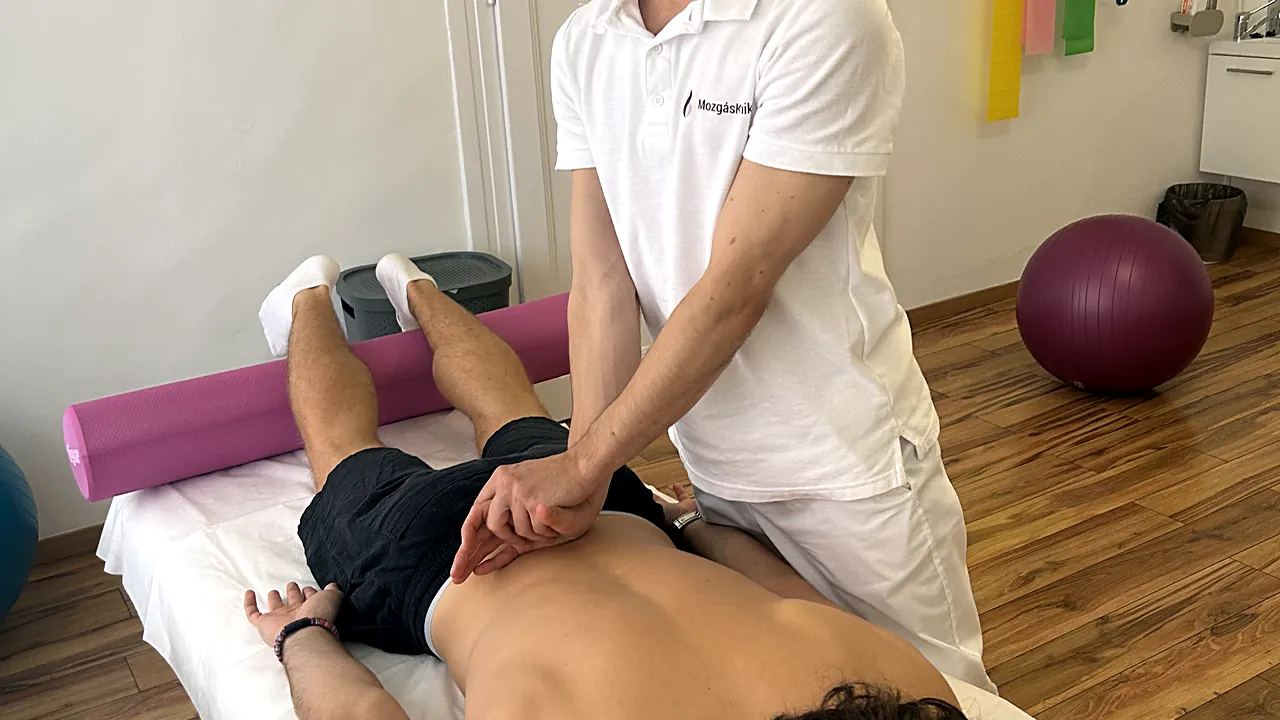
- Manual therapy for the forearm muscles and the elbow and wrist joints, and where needed the shoulder and neck as well. More on what this involves in our manual therapy article.
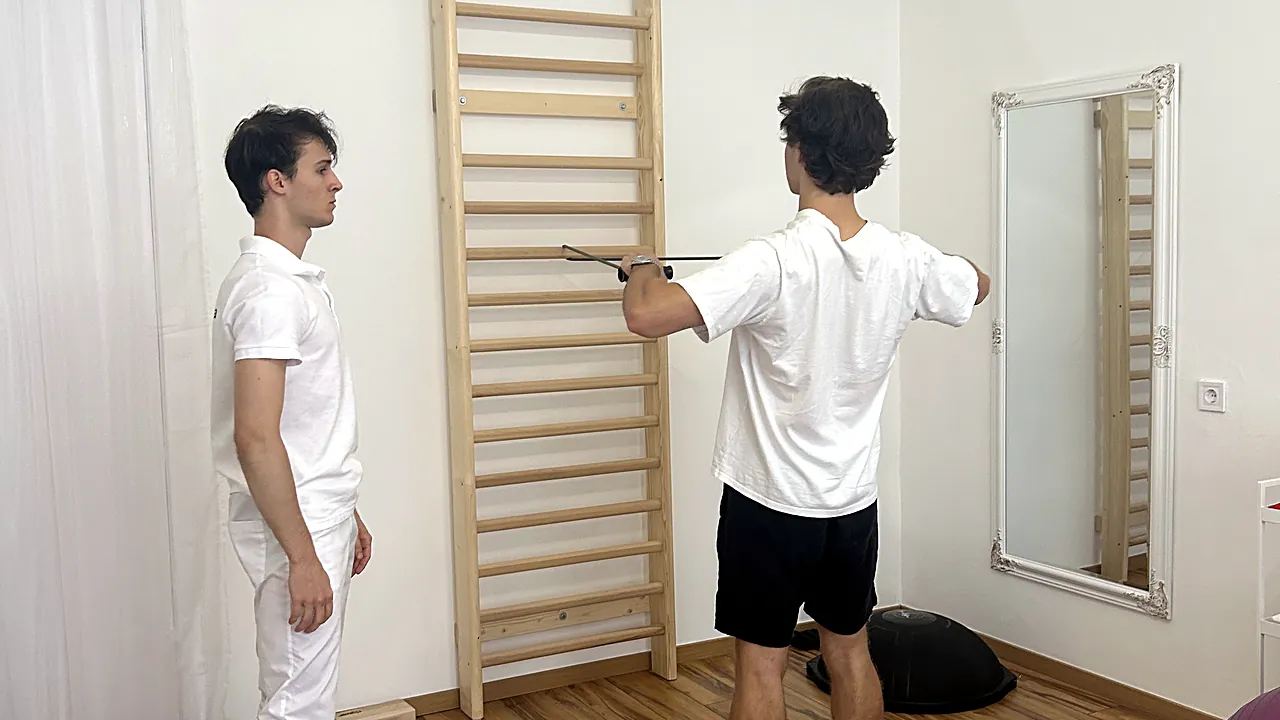
- Exercise therapy – progressively harder exercises for the forearm, grip and shoulder blade stability, which you continue at home.
- Kinesiology tape to offload the forearm.
- Physical therapy add-ons such as ultrasound or shockwave.
- Practical advice on load at work and at home: mouse grip, lifting technique, training volume.
How it works with us
- We map it out – we ask when and what makes it hurt, what your work and sport involve, then test the elbow, wrist and shoulder. There’s a separate article on your first assessment.
- We tailor the treatment plan to you – based on the findings, your daily load and your goal, whether that’s getting back on court or just working without pain.
- We get started at your first visit – the assessment isn’t a separate appointment; treatment begins in the same session.
Treatment is carried out by our experienced physiotherapists in the 13th district. Book a consultation (opens in a new tab)
Who is the Váci út clinic handy for?
If you work in the offices opposite Westend, there’s no need to cross the city for your elbow: the clinic sits between Lehel tér and Nyugati, near the DM on Váci út. (Monday to Friday, 8:00–20:00) The M3 metro stops at Lehel tér and Nyugati pályaudvar, trams 4 and 6 stop at Nyugati tér, and if you drive you can park in the Westend underground car park and just cross Váci út. It’s also easy to reach from Újlipótváros and the Szent István park side. It’s about an 11-minute walk from Szent István park. Inside the building, a few steps lead to a lift up to the mezzanine. Full directions: how to find us by Westend.
Frequently asked questions
Do I need a referral for tennis elbow treatment?
As a private clinic, we see patients without a referral. If you have earlier reports, an ultrasound or an MRI, bring them along and we’ll go through them at the assessment.
How many sessions will I need?
We can’t promise a number in advance – it depends on how long you’ve had the problem, your daily load and how you respond to treatment. At the first level of the MozgásPiramis® method, the clinic’s protocol is 12 sessions, twice a week, but the number of sessions varies from person to person.
Can I keep playing tennis or working during treatment?
In most cases yes, with adjusted load – stopping completely is rarely the goal. How much and how, we decide together after your assessment.
How much does it cost, and can I use insurance?
You can pay by cash, bank card or SZÉP card, and we can issue invoices for Hungarian health funds. Please note that we issue Hungarian invoices only and can’t complete forms for foreign insurers; claiming reimbursement is the patient’s responsibility. Current fees are on our prices page.
The sooner you deal with it, the less time your arm spends learning to work around pain. If you have a question, call us on +36 30 790 6270, or book a consultation (opens in a new tab) and we’ll look at what’s loading your elbow together, just across from Westend.